
Human resources (HR) in 2026 continues to face ever-evolving challenges relating to technology, retention, and employee expectations. At the heart of HR, though, the focus remains the same: how to engage your people to do their best work, and feel motivated right from the word go, whether they are stepping through the office door or opening their laptop at home.
In this context, we have gathered the latest HR statistics and industry trends to help bring HR leaders and hiring managers up to speed with what to prioritize in 2026. With these in hand, you will be better equipped to implement relevant strategies that resonate with your teams. The main themes these HR statistics cover include:
- General HR statistics
- HR statistics on work culture
- HR statistics on recruitment and retention
- Employee engagement statistics
- HR statistics on employee development
- HR statistics on hybrid and remote work
- HR statistics on artificial intelligence and AI technology
General HR statistics
Though the spotlight continues to shine on trends like artificial intelligence and technology in 2026, people-first HR remains center stage for businesses looking to keep their employees happy and engaged. With this in mind, let’s begin with HR statistics that paint the backdrop, providing some context for the year ahead.
- 46% of HR professionals have only 2 years or less of experience in their role. (Paycor)
- 13% of companies are responding to resource restraints by cutting HR budgets, with an average drop of 22%. (McKinsey & Co.)
- Human resources make up a meagre 2% of the total US workforce. (AIHR)
- HR professionals skew more towards female employees (68%), compared to the total US workforce (49%). (AIHR)
- Many HR professionals (72%) go into human resources prior to age 30, but with pre-existing experience in other disciplines. (AIHR)
HR statistics on work culture
Work culture is the bedrock of many effective HR operations. With a strong foundation of clearly communicated values, your employees know where they stand and what is expected of them in the workplace. A healthy work culture also fosters a sense of security and inclusion that can help your employees feel like they really belong at the company.
- Businesses that intentionally incorporate company culture into day-to-day workplace routines experience a 34% increase in employee performance compared to those that don’t. (Gartner)
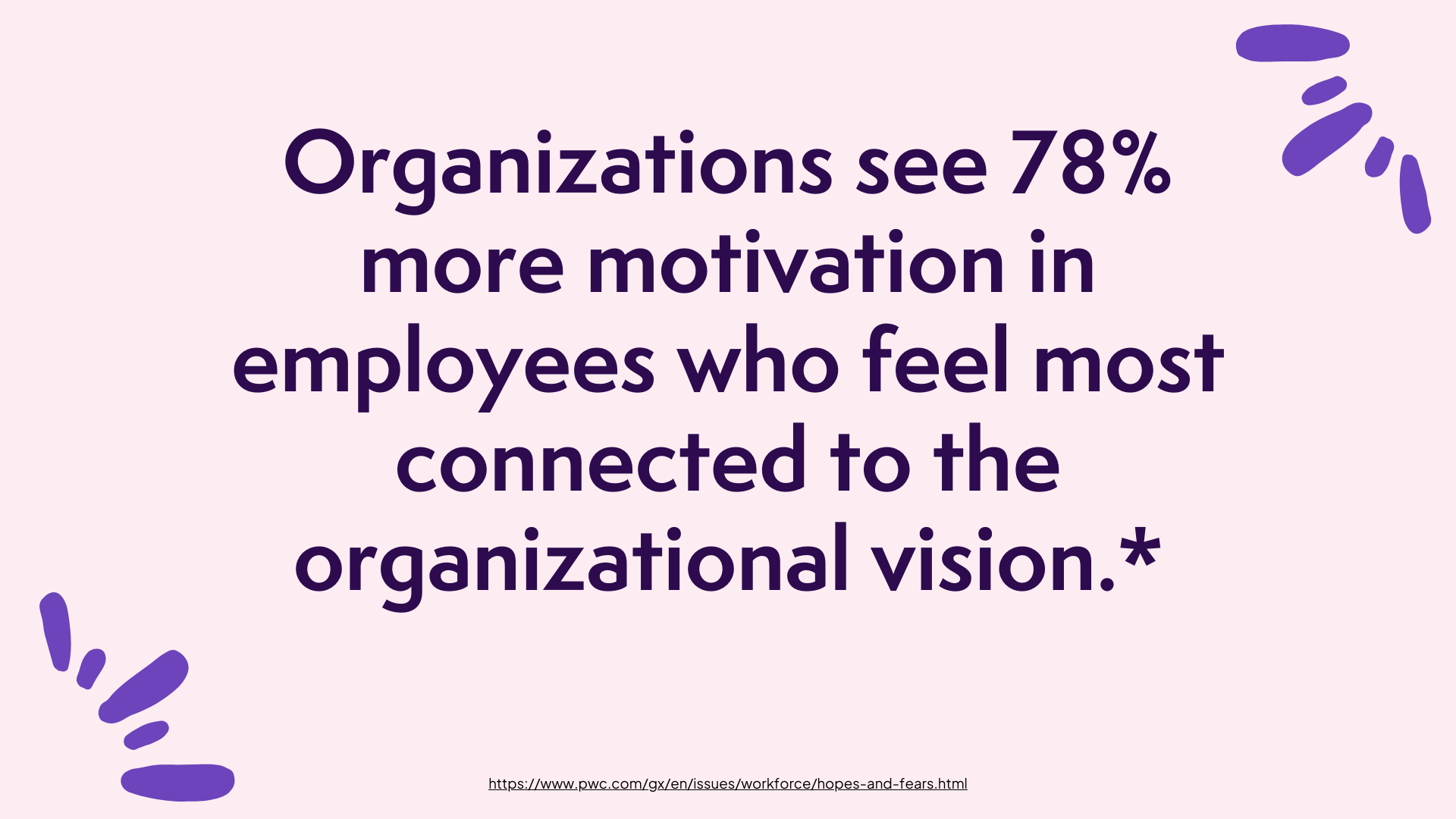
- Organizations see 78% more motivation in employees who feel most connected to the organizational vision, as opposed to those who don’t. (PwC)
- When a company has a clear sense of purpose, it is 2x more likely to push for ambitious high-growth strategies. (PwC)
- Of those same companies, 33% encourage a culture of innovation. (PwC)
- A third of workers have left a job due to their personal values clashing with those of leadership. (Randstad)
- A toxic work culture drives 44% of workers to quit. (Randstad)
- Conversely, 83% of people are positively disposed towards workplaces that provide a sense of community. (Randstad)
HR statistics on recruitment and retention
Once you have embedded a healthy workplace culture, it should naturally be easy to improve recruitment and retention. From evolving employee priorities to an ever-larger demographic of Gen Z job seekers, this looks far different today than it did five (or even two!) years ago.
- 84% of hiring managers struggle to find the talent they need to fill open positions. (Globalization Partners)
- 61% of HR professionals at private organization expect hiring processes to become more competitive due to new US tariff policies. (Gartner)
- Higher pay remains a priority for job applicants, with 53% naming it as a key incentive for accepting a job offer. (Gartner)
- The top three things job seekers look for in a new job are fair compensation through better pay and benefits (23%), flexible work arrangements (15%), and career growth opportunities (14%). (Paycor)
- 32% of Gen Z employees rate work-life balance as what they look for most in a job. This ranks higher than career development (22%) and compensation (20%). (SurveyMonkey)
- 34% of women choose to remain in a job because it has a good work-life balance. (SurveyMonkey)
- 18% of new hires do not stay on past the probationary period. (McKinsey & Co)
- Those who have been employed for less than two years are 38% more likely to quit than long-term employees. (Paycor)
- Despite falling employee engagement, 82% of workers do feel secure in their current place of employment. (TalentLMS)
Employee engagement statistics
Employee retention and employee engagement are closely interlinked, and it’s no wonder. When employees are engaged with and enjoy their work, they are far less likely to seek greener pastures elsewhere. Unfortunately, employee engagement statistics show some concerning trends.
- “Quiet cracking,” a new buzzword describing a persistent sense of workplace dissatisfaction, is experienced by 54% of employees. (TalentLMS)
- Only 21% of employees are engaged in the workplace. (Gallup)
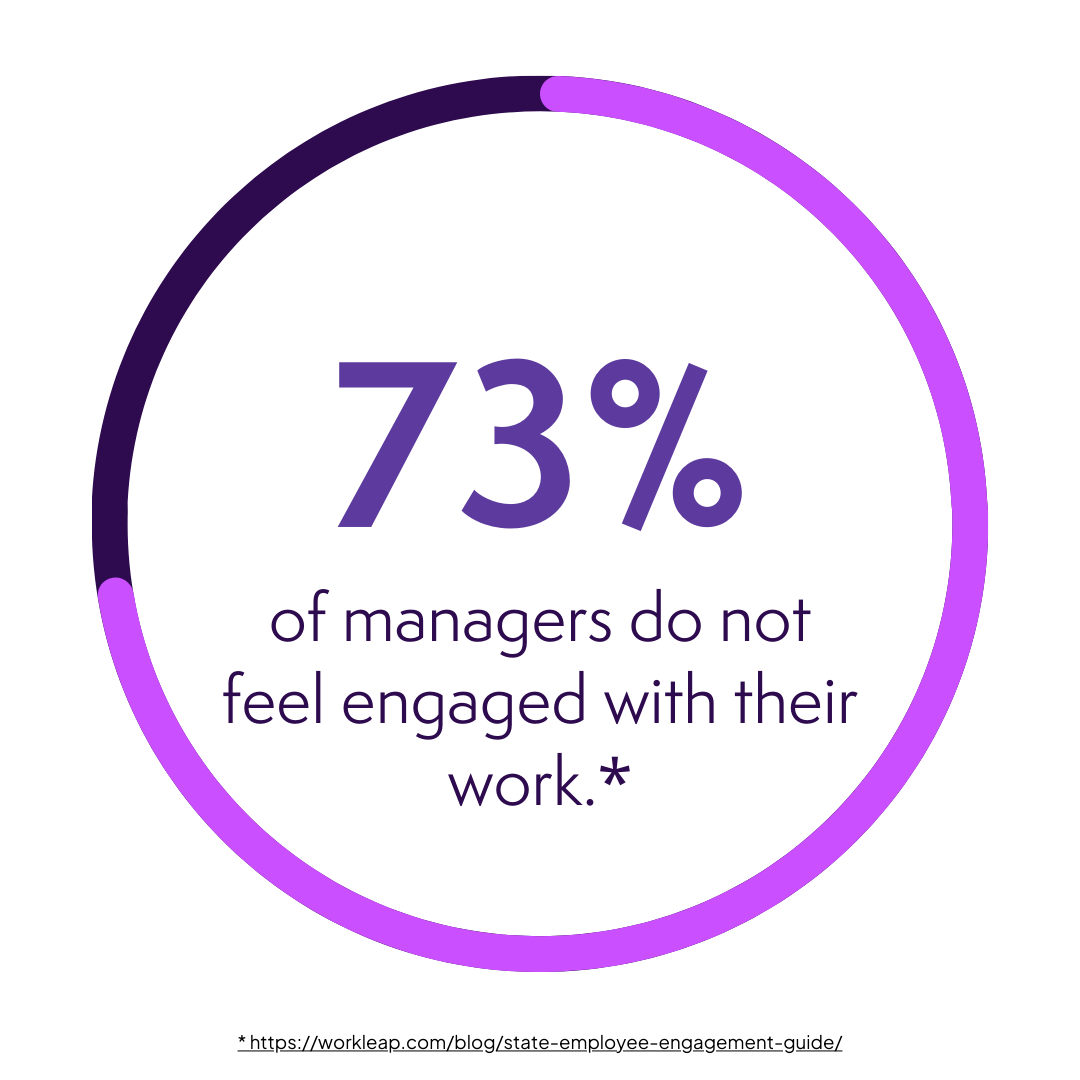
- 73% of managers do not feel engaged with their work. (Gallup)
- In the course of a year, employee apathy results in a staggering loss of $438 billion to the world economy. (Gallup)
- On the flip side, it is estimated that the global economy could increase by $9 trillion in productivity gains if employees were engaged. (Gallup)
- Workers employed at successful companies are 397% more likely to describe leaders as “engaged” and “inspirational.” (Paycor)
HR statistics on employee development
One of the best ways to engage your employees is to provide them with professional development opportunities. People need a sense of direction in their professional careers, and up- or re-skilling is a key way to provide this. Whether through arranging training or organizing employee resource groups (ERGS), investing in your team is a win-win. Individuals get to grow their skills, and the organization benefits from their talents.
- Only 44% of managers have received management skills development. (Gallup)
- Following targeted coaching, management performance increased by 28%. (Gallup)
- When management training is combined with a colleague investing in their growth, managers are 50% more likely to excel in their role. (Gallup)
- 26% of employees received no guidance in the last year to help them develop professionally. (McKinsey & Co.)
- 42% of workers report not receiving any training opportunities from their employer in the last year. (TalentLMS)
- Employers forecast that 39% of essential employee skills will change dramatically by 2030. (World Economic Forum)
- Nearly 80% of employers rate talent management as one of the top ten skills of importance for the next five years. (World Economic Forum)

HR statistics on hybrid and remote work
It is clear that the modern workplace has changed, and the genie cannot be put back in the bottle. In 2026, hybrid and remote working will continue to benefit both employees (in terms of work-life balance) and employers (in terms of wider talent acquisition).
- 48% of HR leaders have determined which positions are most suitable for hybrid/remote work. (Mercer)
- Creative marketing and technology fields have the highest rates of hybrid and/or remote work opportunities, with around 30% hybrid and 15% fully remote. (Robert Half)
- 25% of workplaces allow their employees to work remotely at least some of the time. (Robert Half)
- Hybrid working has made teams more effective, according to 69% of managers. (Owl Labs)
- Almost three-quarters of employers have not changed their hybrid working policy in the last 12 months. (Owl Labs)
- 39% of workers go into the office three times per week, followed by 34% four times per week, 22% twice a week, and only 5% once a week. (Owl Labs)
- Hybrid and remote working is enjoyed by 40% of Gen Z employees, compared to only 17% of Baby Boomers. (Randstad)
HR statistics on artificial intelligence and AI technology
Another trend for 2026 is “human-centric AI,” with HR professionals expected to not only use AI but to blend it strategically with HR processes. Though job postings and descriptions are changing to accommodate greater AI skill expectations, more work needs to be done to get HR professionals and other employees up to speed with new technology.
- 77% of employees feel that AI use has increased their workload. (Upwork)
- 96% of senior leaders expect AI tools to increase productivity. (Upwork)
- However, nearly half of employees are unsure how to use AI to increase their productivity. (Upwork)
- Approximately 9 in 10 employers have named AI and big data as the most sought-after skills for the next five years. (World Economic Forum)
- Implementing HR technology or better capitalizing on existing technology has gone from 13th to 6th place in HR priorities. (Mercer)
- 8 in 10 jobs are expected to be altered by generative AI. (Mercer)
- Only 18% of companies with 1000+ employees use shared service centres (SSCs) to support HR demands. (McKinsey & Co.)
- 89% of HR leaders aim to increase their HR technology budget. (Gartner)
- 82% of HR leaders are relying on AI tools to secure organizational success. (Globalization Partners)

How Axero can help enhance HR operations
Not sure where to begin with incorporating human-centric technology into your HR functions? Axero’s modern intranet is a great place for your HR team to start. Our award-winning platform empowers your employees and wider teams to communicate, manage information and resources, and keep everyone posted and engaged.
Think of it as your online office space, with many more tools to make work work, from onboarding checklists and launchpads to peer recognition and AI knowledge management, just to name a few.
Keen to know what Axero can do to help HR teams take HR initiatives to a whole new level? Get a personalized demo and find out today.






 info@axerosolutions.com
 1-855-AXERO-55