Employee self-service portals have become a core component of modern workplaces. Organizations want employees to find information, complete HR tasks, and access resources without relying on emails or manual processes. When you centralize tools, documents, and updates in one place, you reduce administrative work and create a smoother experience for every employee. These portals also give teams more visibility into company information and their own data, from HR records to policy documents to workplace announcements.
As more companies adopt digital-first operations, the demand for employee self-service tools continues to grow. Many HR platforms now offer varying degrees of self-service, but the experience differs widely between systems. Some tools act as basic hubs for personal details and time-off requests, while others support communication, collaboration, workflows, and company-wide knowledge sharing.
A strong employee self-service portal should help people complete tasks quickly and stay informed. It should also support HR teams by reducing repeat questions, automating routine processes, and encouraging employees to self-serve information.
Top 12 employee self-service portal software for 2025
- Axero
- BambooHR
- UKG Ready
- Trinet
- Zoho People
- SAP SuccessFactors
- Oracle HCM Cloud
- Rippling
- PeopleSoft
- Paycor
- ADP Workforce Now
- Freshteam
What is employee self-service portal software?
Employee self-service portal software provides a centralized space where employees can access personal information, manage HR-related tasks, and stay connected to company updates. Core features typically include accessing pay details, updating personal records, requesting time off, reviewing company policies, and submitting forms.
Instead of routing every request through HR or managers, the portal empowers employees to complete tasks independently. This reduces administrative workload and improves accuracy because people can update their own information directly. Modern employee self-service systems often extend beyond HR functions and become part of larger digital workplace strategies. They may include communication tools, document management, collaboration spaces, and customizable dashboards that support daily work.
When deployed effectively, an employee self-service portal helps employees find what they need when they need it, leading to a more efficient and informed workplace.
What to consider when choosing the right employee self-service portal software
Choosing the right self-service solution depends on your teams’ needs, how your business operates, and how you expect the platform to grow with you. Focus on usability, functionality, and long-term fit. A strong employee portal should streamline workflows, reduce manual work, and help people find answers without friction.
User-friendly design
A simple interface ensures employees can log in, navigate, and complete tasks without training. Clear menus, intuitive layouts, and mobile access improve adoption.
Integration capabilities
Your employee portal should integrate with HRIS platforms, payroll, communication tools, and third-party apps. Strong integrations reduce duplication and help employees work from one place.
Customizability
Every organization structures information differently. Look for tools that allow you to adjust layouts, dashboards, forms, and permissions to match your processes.
Security and access control
Employee data requires strong protection. Choose platforms that offer encryption, multi-factor authentication, role-based permissions, and compliance features.
Knowledge access
Employees should be able to find policies, procedures, and resources quickly. A searchable knowledge base improves self-service and reduces repetitive questions.
12 best employee self-service portal software
1. Axero
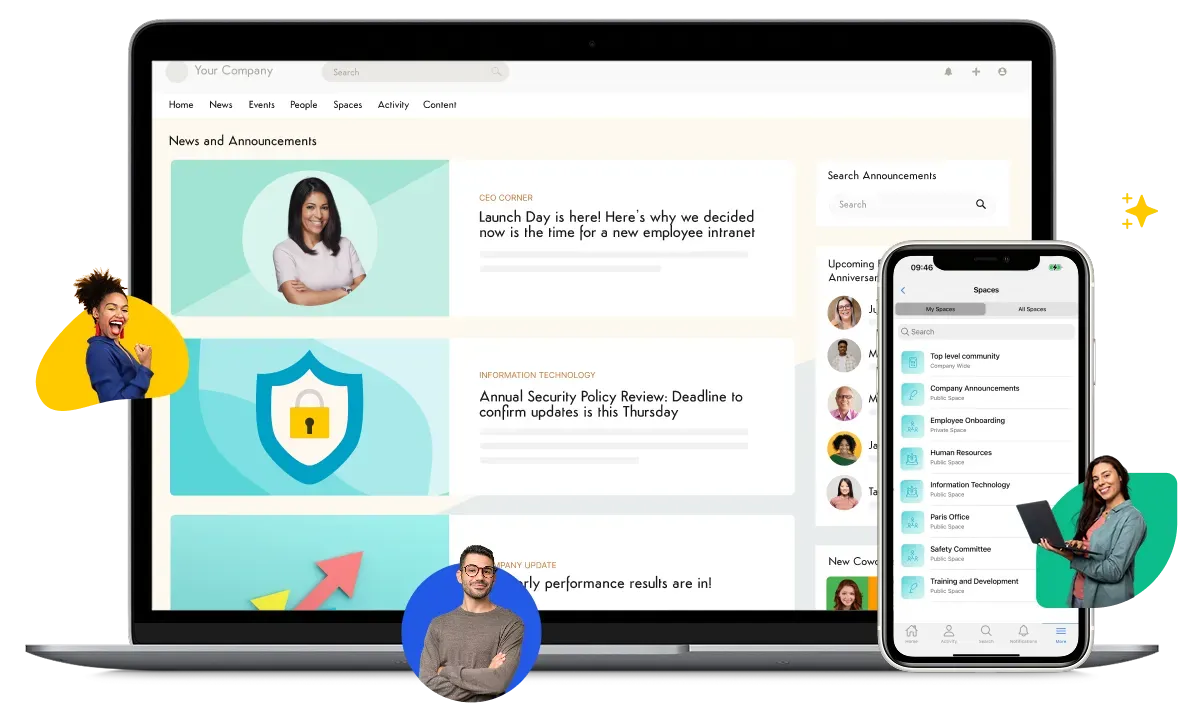
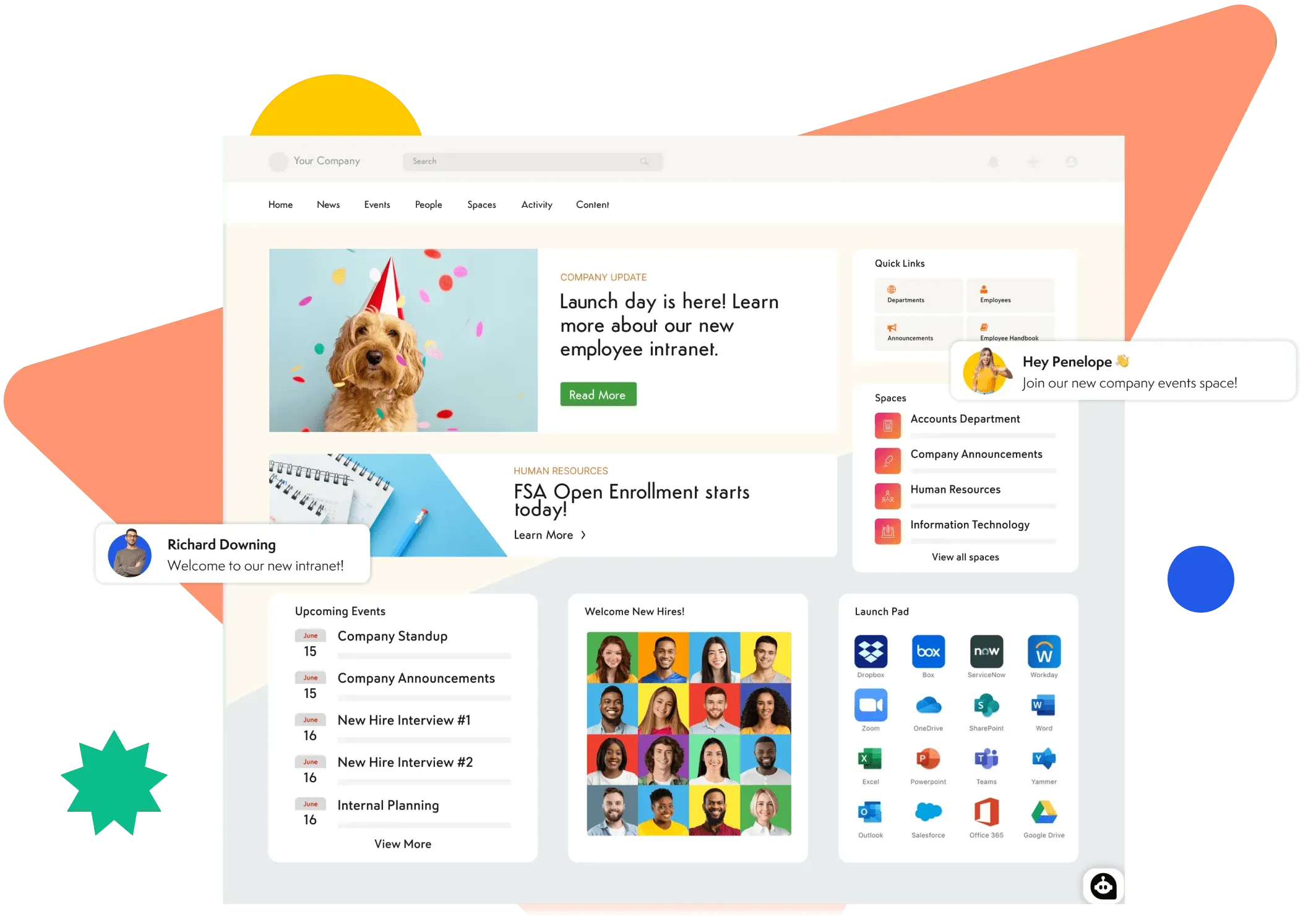
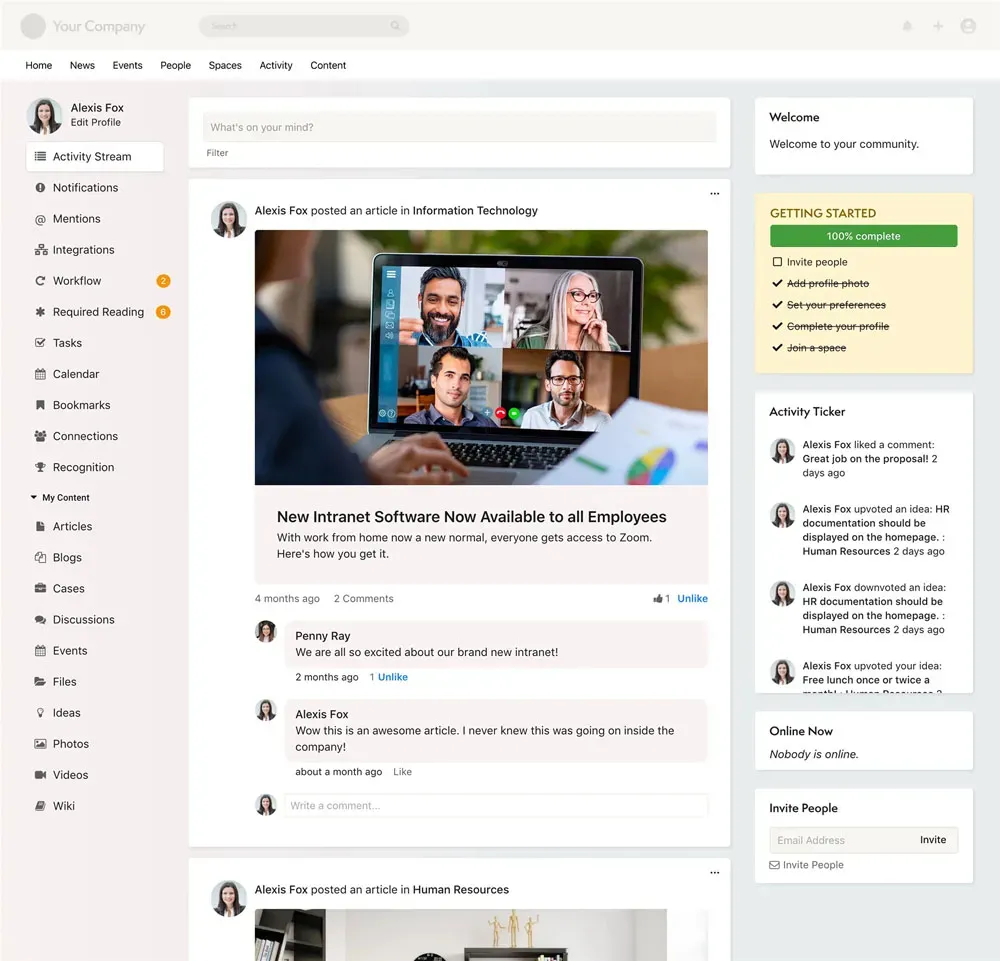
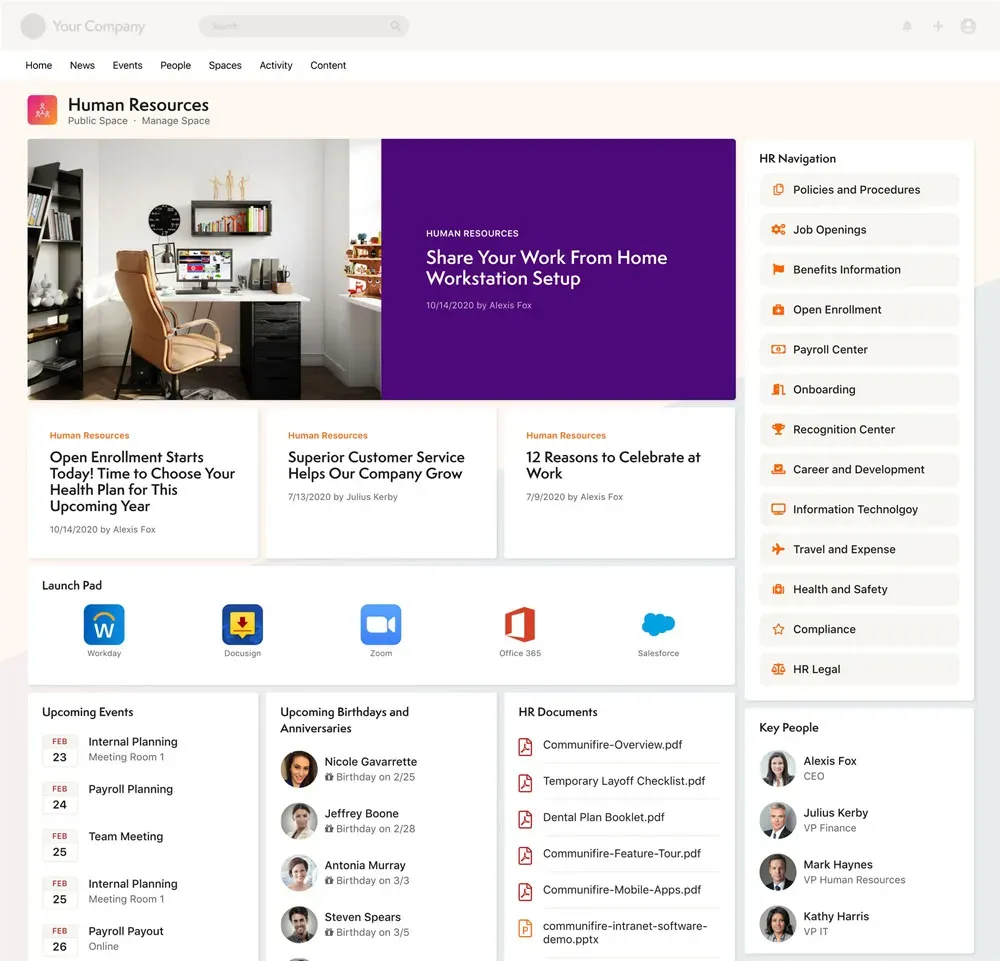
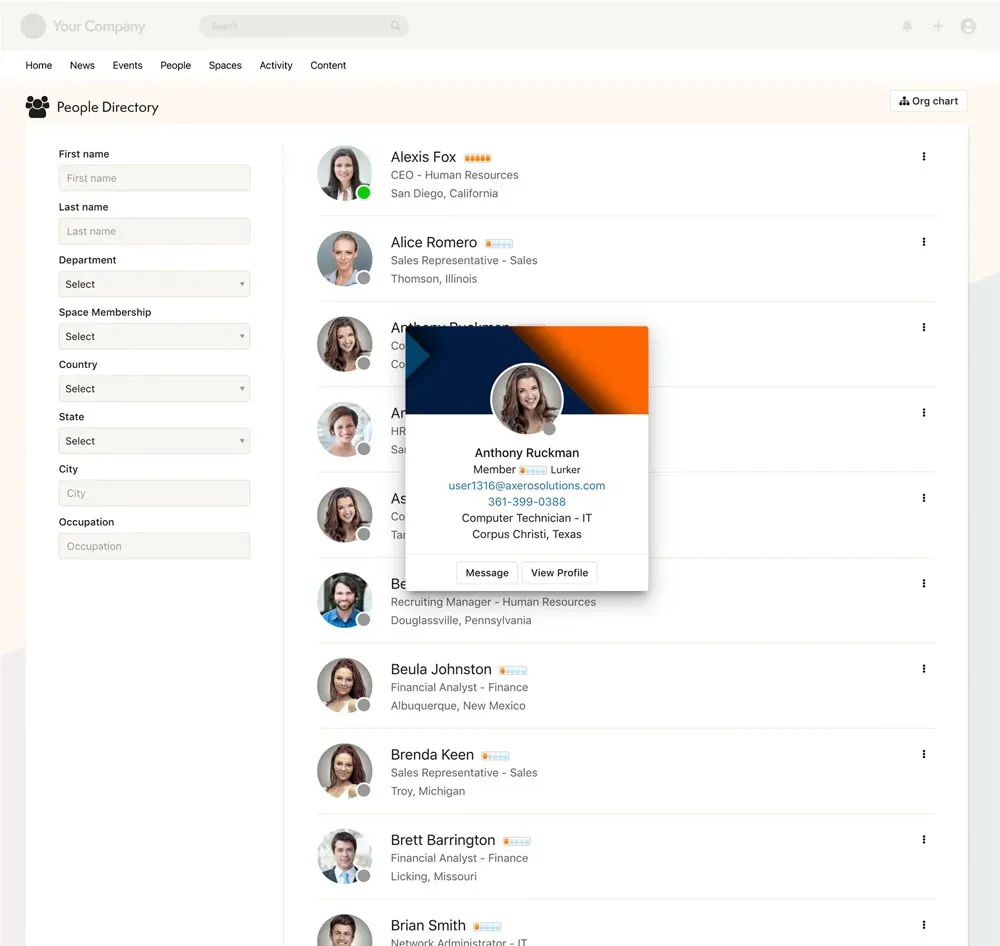
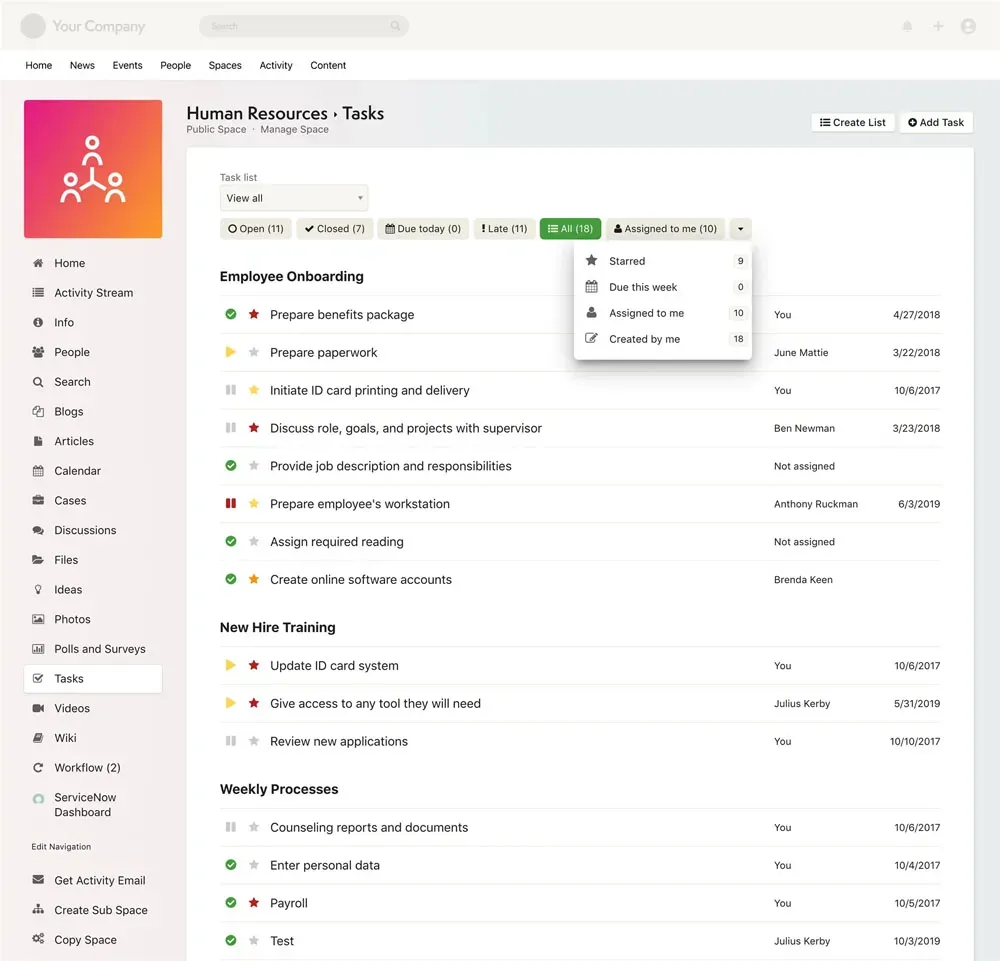
Axero combines intranet, communication, collaboration, and HR self-service tools into one unified platform. It gives employees a single place to update their information, request time off, access documents, find policies, and stay connected to the organization. HR teams benefit from centralized knowledge, automated workflows, and customizable forms that standardize common processes.
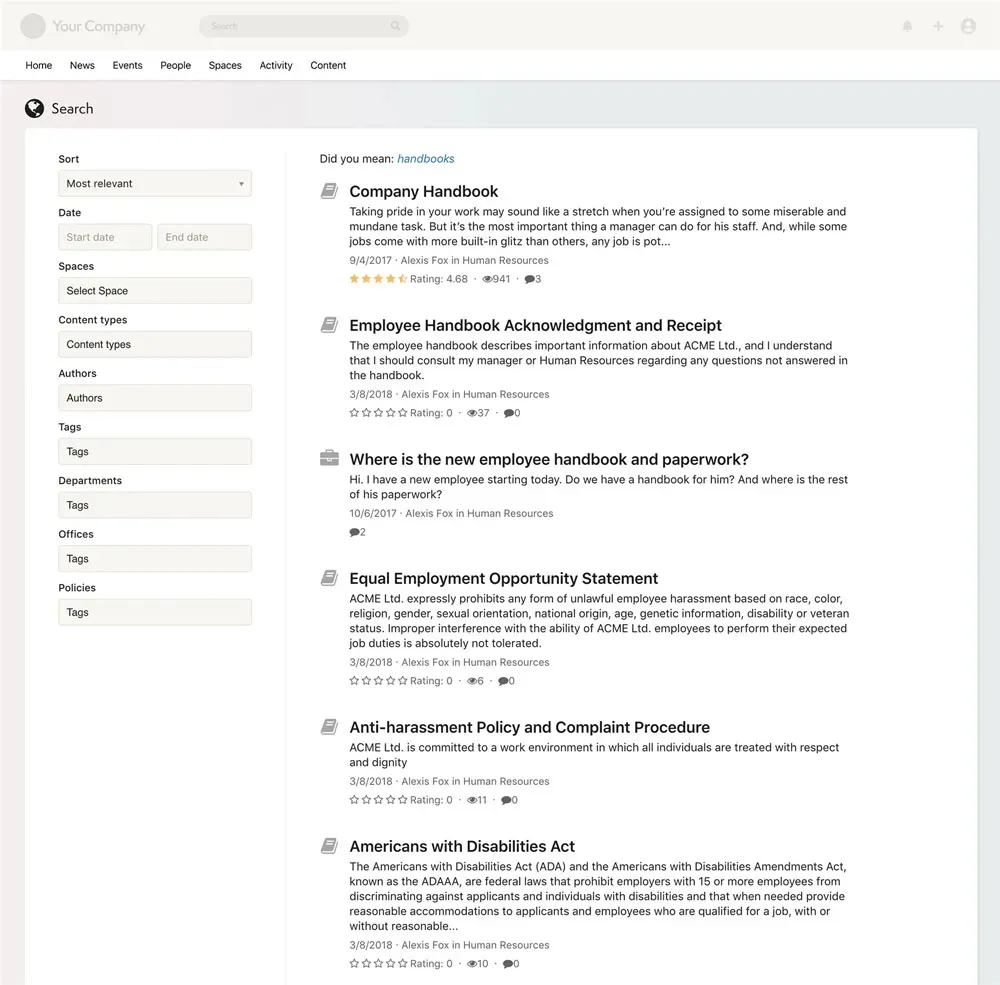
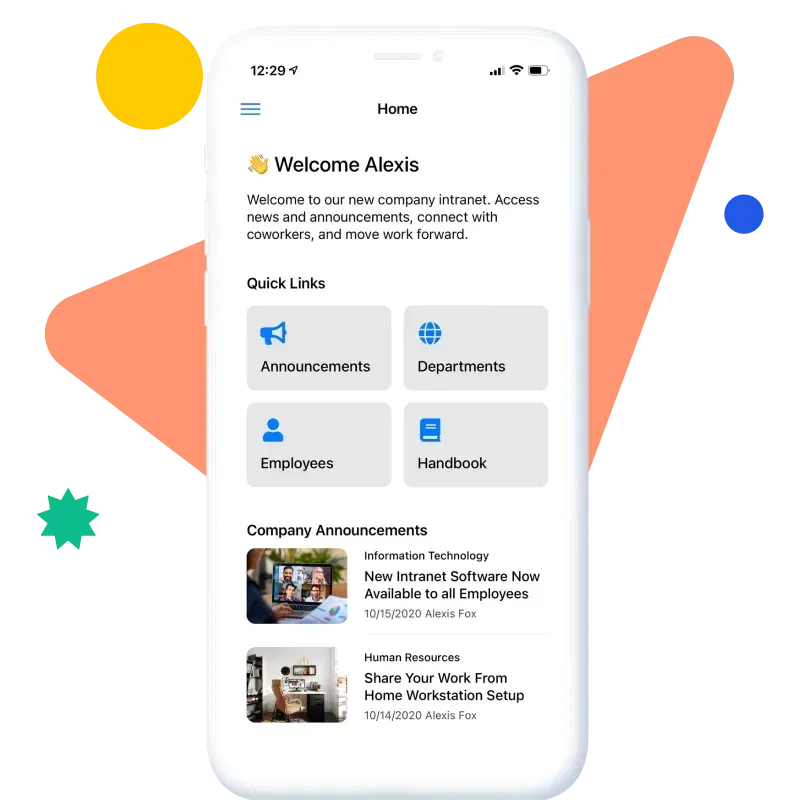
Axero’s interface is simple to navigate, which helps drive adoption across different departments and workforce types. The platform’s flexibility allows organizations to configure dashboards, pages, and workspaces to match internal processes. Axero also supports communication features like announcements, social feeds, and communities, giving employees broader visibility into company activity. With strong search functionality, employees can easily find answers and complete tasks without contacting HR. This reduces administrative overhead and creates a more efficient employee experience.
Key Features of Axero
- Customizable forms: Helps HR teams streamline time-off requests, onboarding tasks, and other key workflows.
- Centralized knowledge base: Gives employees quick access to policies and documents.
- Unified communication tools: Helps employees stay informed about company updates.
Best for: Organizations that want a central hub for HR self-service, communication, and knowledge sharing.
2. BambooHR
BambooHR is known for its clean interface and HR-focused approach. Its employee self-service features allow team members to access their personal records, request leave, update information, and view documents. The platform’s People Data & Analytics tools help HR teams manage employee details and track key workforce insights. BambooHR offers employee-focused self-service elements such as time tracking, performance management, and company-wide document distribution. It is designed for HR teams that want simplicity and ease of use, without heavy configuration.
Key Features of BambooHR
- Employee self-updates: Allows employees to manage personal information.
- Time-off management: Simplifies leave requests and approvals.
- Document storage: Gives employees access to policies and files.
Best for: Small to mid-sized companies looking for an intuitive HRIS with straightforward self-service tools.
3. UKG Ready
UKG Ready offers workforce management and HR tools designed for accuracy and compliance. The self-service portal lets employees handle timekeeping tasks, review schedules, access pay information, request time off, and update personal data. UKG Ready is built to support businesses with complex scheduling or compliance requirements. Its dashboards and reporting tools help HR teams monitor workforce insights, while employees benefit from clear access to information through desktop and mobile.
Key Features of UKG Ready
- Employee time management: Gives employees visibility and control over timekeeping.
- Scheduling tools: Helps teams view and adjust schedules easily.
- Compliance support: Helps maintain accurate records.
Best for: Organizations with hourly workers or complex scheduling needs.
4. Trinet
Trinet provides an HR platform centered on benefits administration, payroll, and time management, with an employee self-service experience designed to simplify everyday tasks. Employees can review their benefits, request time off, update personal information, complete onboarding steps, and access pay-related documents. The platform focuses on reducing manual HR work by automating common processes and giving employees clear visibility into their information. Trinet also offers mobile access, which supports employees who need to complete tasks on the go. Its clean interface and guided workflows help teams understand what actions they need to take. HR teams benefit from automated compliance tools, streamlined reporting, and integrations with commonly used payroll and benefits providers.
Key Features of Trinet
- Self-service benefits management: Helps employees review and select benefit plans.
- Automated workflows: Reduces repetitive HR tasks.
- Mobile access: Allows employees to complete tasks anytime.
Best for: Companies that prioritize benefits management and want a simplified user experience.
5. Zoho People
Zoho People is a flexible HR platform designed to support growing teams. Its employee self-service portal gives employees access to attendance records, time-off balances, announcements, and personal information. Zoho People includes customizable forms, which help standardize HR requests and streamline administrative tasks. The platform also supports performance management, learning modules, and policy management, giving employees one place to manage various HR interactions. Its modular design makes it adaptable for organizations that need both basic and advanced HR features.
Key Features of Zoho People
- Attendance and time tracking: Gives employees real-time access to their records.
- Custom forms: Helps HR teams automate requests and approvals.
- Performance modules: Supports reviews and goal tracking.
Best for: Growing businesses that want a configurable and scalable HR system.
6. SAP SuccessFactors
SAP SuccessFactors is a comprehensive HCM platform used by large enterprises with complex HR needs. The employee self-service features allow employees to manage personal data, review pay details, apply for leave, access learning content, and complete performance activities. The platform emphasizes workforce planning, learning, and talent management, with deep reporting and analytics capabilities. Its self-service features are embedded within larger HR workflows, giving employees visibility into their development paths, goals, and records. SuccessFactors integrates with many enterprise tools and supports global organizations with multilanguage and compliance features.
Key Features of SAP SuccessFactors
- Integrated talent and learning tools: Helps employees manage development tasks.
- Self-service personal data updates: Reduces reliance on HR support.
- Enterprise-grade reporting: Helps leaders analyze workforce metrics.
Best for: Large organizations with sophisticated HR requirements.
7. Oracle HCM Cloud
Oracle HCM Cloud offers a wide range of HR functionalities, with a strong self-service experience designed to help employees manage personal data, access pay information, review schedules, complete forms, and engage with performance and development activities. Its interface supports personalized dashboards that help employees see relevant tasks and updates at a glance. Oracle HCM Cloud also focuses on automation and analytics, giving HR teams visibility into workforce patterns and helping reduce manual data entry. With robust integration options and multilanguage support, it works well for distributed and global teams.
Key Features of Oracle HCM Cloud
- Personalized dashboards: Gives employees a tailored view of their tasks.
- Automated HR workflows: Reduces manual administration.
- Analytics tools: Supports better workforce planning.
Best for: Global enterprises that need customizable and data-driven HR operations.
8. Rippling
Rippling combines HR, IT, and financial operations into a unified platform, giving employees one place to manage a variety of tasks. Through the self-service portal, employees can update personal information, review pay details, manage benefits, complete onboarding steps, and access important documents. Rippling’s strength comes from its automation engine, which triggers workflows across different systems. This helps HR teams streamline tasks such as onboarding, equipment provisioning, and role-based permissions. Employees benefit from a simplified experience because everything they need lives in one place, including integrations with third-party tools managed by the organization. Rippling’s modular setup makes it easy for companies to expand capabilities as needs evolve.
Key Features of Rippling
- Unified HR and IT workflows: Helps teams manage tasks across systems.
- Self-service records updates: Reduces administrative involvement.
- Automated onboarding: Simplifies first-day processes.
Best for: Organizations that want an integrated approach to HR, IT, and operations.
9. PeopleSoft
PeopleSoft, part of the Oracle suite, provides HR management tools tailored for large organizations with complex requirements. Its employee self-service features allow employees to manage personal information, view pay data, submit requests, update details, and interact with HR forms. PeopleSoft focuses heavily on configuration, allowing organizations to adapt the system to internal processes. While it often requires more setup compared to newer HR platforms, its depth makes it a reliable option for enterprises that need detailed customization. Employees benefit from structured workflows and consistent access to HR information, while HR teams gain visibility into compliance data and workforce records.
Key Features of PeopleSoft
- Configurable workflows: Aligns HR tasks with organizational processes.
- Self-service forms: Helps employees complete requests efficiently.
- Robust HR data management: Supports large-scale workforce needs.
Best for: Large enterprises with complex HR structures requiring high configurability.
10. Paycor
Paycor delivers HR, payroll, and workforce management tools built for organizations that want a simple employee self-service experience. Employees can access pay stubs, update personal information, request time off, and complete HR tasks from desktop or mobile. Paycor’s interface is designed to minimize confusion and reduce questions directed at HR teams. Its onboarding tools allow employees to complete their documents digitally, helping HR automate early processes. Paycor also includes performance and scheduling capabilities, giving employees visibility across multiple areas of their work.
Key Features of Paycor
- Mobile-friendly portal: Helps employees manage HR tasks anywhere.
- Digital onboarding: Reduces paperwork and speeds up setup.
- Self-service time-off requests: Simplifies leave management.
Best for: Organizations looking for a straightforward and mobile-focused HR platform.
11. ADP Workforce Now
ADP Workforce Now is a widely used HR and payroll platform offering an employee self-service experience to support organizations of all sizes. Employees can manage personal information, review pay statements, update tax documents, request time off, and access company resources. The platform is known for its payroll accuracy and compliance tools. HR teams benefit from detailed reporting, automated workflows, and strong integration capabilities. ADP’s mobile app gives employees consistent access to HR details, helping reduce administrative requests. Its flexibility makes it a common choice across industries with diverse workforce needs.
Key Features of ADP Workforce Now
- Self-service payroll access: Helps employees access pay and tax information.
- Mobile HR tools: Makes essential tasks easy to complete.
- Integration support: Connects with third-party systems.
Best for: Organizations that prioritize payroll accuracy and need a dependable HR solution.
12. Freshteam
Freshteam, part of the Freshworks suite, supports basic HR functions with a streamlined self-service portal for employees. Employees can view personal details, complete onboarding tasks, request time off, and access company documents. The platform focuses on simplicity and is designed for teams that want essential HR tools without added complexity. HR teams can manage applicant tracking, employee records, and time-off workflows from the same system. Freshteam’s lightweight structure makes it an approachable option for smaller teams adopting digital HR tools for the first time.
Key Features of Freshteam
- Simple employee portal: Helps employees complete essential HR tasks.
- Onboarding workflows: Guides new hires through required steps.
- Time-off management: Supports clear approval processes.
Best for: Small teams seeking an easy-to-use HR system.
Choosing the right employee self-service portal
Employee self-service portals support HR teams and employees by centralizing information, tasks, and processes. When employees can update their information, submit requests, and find answers on their own, HR teams spend less time on repetitive tasks. The right platform should help people work efficiently, strengthen communication, and create a dependable place for company knowledge. It should also integrate with tools you already use and scale as your organization grows.
A platform like Axero provides a unified space where HR information, communication tools, and knowledge live together. This helps reduce confusion, supports consistent processes, and gives employees a reliable hub for their everyday needs. Ready to see how a modern intranet can transform the employee experience? Book a demo today.


info@axerosolutions.com
1-855-AXERO-55