


What internal communications actually is (and isn’t)
Internal communications is the practice of moving information, context, and feedback between an organization and the people who work in it — deliberately, to a defined audience, through a channel chosen for the message, with some way of knowing whether it arrived.
That last clause is what separates internal communications from sending things. And it’s worth drawing three boundaries, because internal comms gets confused with all three of its neighbors:
- It isn’t external communications or PR. External comms manages what the market and press believe. Employees behave differently: they already have a relationship with you, they can verify your claims from the inside, and they talk to each other. Copy that works in a press release reads as spin on an intranet homepage.
- It isn’t HR communications. HR comms is a category of internal comms — benefits, policy, performance cycles — usually the largest by volume. But internal comms also carries strategy, operations, safety, IT change, and leadership context. Housing the function inside HR is a common structural choice; treating the whole function as HR’s subject matter is a mistake.
- It isn’t the tool. An intranet, a chat platform, and an email list are channels. A company can own all three and have no internal communications practice — which is how organizations end up with a wiki nobody trusts and an announcements feed nobody reads.
The other distinction that matters is direction. Healthy internal communications runs three ways at once: top-down, where leadership distributes decisions, strategy, and policy — the direction most programs are built around and often the only one measured; bottom-up, where employees surface questions, friction, and early warnings to the people who can act on them, through comments and open Q&A that tell you something is wrong months before a survey would; and horizontal, peer-to-peer across departments and locations, where most institutional knowledge actually moves and where fragmentation does the most damage — two teams solving the same problem in parallel because neither knew about the other.
A program that only does top-down isn’t communicating. It’s publishing.
The biggest internal comms challenges today
Before the ten practices, it’s worth looking at what you’re up against. Gallup’s State of the Global Workplace 2025 put global employee engagement at 21% — a decline that cost the world economy $438 billion in lost productivity. Communication didn’t cause all of that on its own, but it sits upstream of most of it: people who don’t know what’s happening, why it matters, or where they fit rarely stay engaged.
Remote and hybrid fragmentation. When everyone was in a building, physical presence did a lot of unglamorous communication work — the hallway update, the visible whiteboard, the manager who noticed a confused face. Distributed work removes that layer without replacing it. Hybrid is harder than fully remote, because it produces two classes of employee with different information access from the same announcement.
Information overload. Employee attention is contested by chat, email, project tools, ticketing systems, and the intranet, most of it configured to notify by default. Asana’s Anatomy of Work Index found that keeping up with email and notification volume is the leading reason nearly a third of employees regularly work late or after hours, and that knowledge workers spend only about a quarter of their time on the skilled work they were hired for — the rest goes to “work about work.” Adding volume to a saturated channel doesn’t increase reach; past a point it reduces it, because employees develop defensive filtering habits that don’t distinguish the newsletter from the safety notice.
Frontline disconnection. Manufacturing, retail, healthcare, logistics, and facilities staff often have no corporate email address, no assigned desk, and no reason to open a laptop during a shift, and they’re frequently the employees for whom a missed policy update carries the most operational or safety risk. The imbalance is long-standing: Emergence Capital’s research on the deskless workforce put roughly 80% of the global workforce (about 2.7 billion people) in deskless roles receiving a small fraction of enterprise software investment. That figure is the industry’s standard reference point rather than a fresh 2026 number, and the pattern it describes hasn’t changed. Most programs are designed by desk workers, tested on desk workers, and quietly fail everyone else.
A multi-generational workforce. Four generations are working simultaneously, with real differences in channel preference and assumptions about response time. The real failure has nothing to do with generational stereotypes. It comes from picking one register and one channel and assuming it reads the same way to a 24-year-old in support as it does to a 61-year-old in operations.
Tool sprawl and unclear ownership. Most organizations acquired their communication stack incrementally, by department, over years. Precise app counts are worth treating carefully — the 2026 SaaS management reports disagree by methodology, with Zylo, BetterCloud, and Productiv putting the average enterprise anywhere from just over 100 applications to well over 300 depending on how you count. The number matters less than the shape: overlapping channels with no agreed purpose, important things posted in three places, unimportant things in the same three, and nobody able to say authoritatively where a given kind of message belongs. Employees respond rationally, by checking none of them carefully.
Internal communications best practices
None of these will surprise you — segment your audience, close the loop on what matters, keep leadership visible. The hard part is doing them consistently, which is why each one below comes with a how, not just a why.
1. Establish one place that’s authoritative
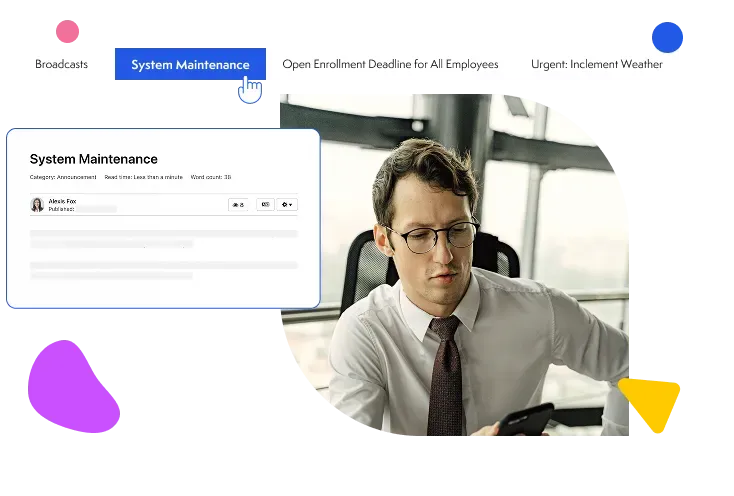
Employees need to know where the real version of something lives — not the most recent version they were sent, the current one, findable on purpose without asking anyone.
The test is specific: can an employee find your current expense policy in under a minute without asking a colleague or searching their inbox? At most organizations the honest answer is no, because it exists in four places — an email from 2024, a shared drive, a PDF in an HR system, an intranet page — with no marker indicating which is live.
How to implement: pick the system of record per content type, publish that decision, then do the unglamorous part and retire the duplicates. A single source of truth isn’t created by launching a platform, it’s created by removing the alternatives. Give every policy page a named owner and a review date, and let content past its review date display as unverified rather than silently presenting as current. A knowledge management layer only earns trust if what’s in it is trustworthy on the day someone reads it.
2. Segment by audience instead of sending everything to everyone
The all-company send is the most overused move in internal comms. Every message that reaches people it doesn’t apply to trains those people to skim the next one.
An update on parking-garage access at one office, for example, is a 90-second read for the 200 people at that office and noise for the other 1,800. Send that pattern weekly for a year and you’ve taught 1,800 people that company announcements are usually irrelevant to them — exactly the habit you don’t want when the safety notice arrives.
How to implement: define your standing audiences before you need them (location, department, role, employment type, shift) as reusable groups rather than recipient lists assembled per send. Then set a default of targeted unless there’s a reason to go wide, and reserve all-company for things that genuinely change everyone’s day. If you can’t name who a message is for, fix the draft before you go anywhere near distribution.
3. Close the loop on the messages that matter
For most communications, “we published it” is a reasonable standard. For a meaningful minority (policy changes, compliance requirements, safety procedures, security updates) it isn’t, and the manufacturer at the top of this guide is why. The distinction is whether you’d need to prove reach later. If an auditor, a regulator, or an incident review might ask “who was informed, and when?”, reach has to be recorded at the time, not reconstructed afterward.
How to implement: classify a small set of your content as requiring acknowledgment, and use a channel that records it. Read receipts and required-reading confirmations turn distribution into evidence: you can see who has acknowledged the change and follow up with the specific 40 people who haven’t, rather than re-sending to everyone. Keep the set small — if everything requires acknowledgment, acknowledgment becomes a reflex click and the record stops meaning anything.
4. Match the channel to the message
Most “nobody reads our comms” complaints are channel-fit problems in disguise. A nuanced organizational change delivered as a chat message will be misread. An urgent shift-coverage request buried in a newsletter will be missed. Neither is a copywriting failure.
How to implement: write down a channel policy, one page rather than a framework document, covering which channel carries which kind of message and what response time each implies. Then hold to it, especially when a senior stakeholder wants to break it. The channel matrix below is a starting point. The value isn’t the specific assignments; it’s that employees can learn them and calibrate their attention accordingly.
5. Make it two-way, and answer in public
Comments and questions on internal content are the cheapest way to sense what’s actually going on, and the most commonly disabled. The stated reason is usually risk. The actual result is that the conversation moves somewhere you can’t see or correct.
The upside is concrete: a benefits change gets announced, three employees ask the same clarifying question in the comments within an hour, and the comms team edits the post to answer it. The other 2,000 employees never have to ask. Without comments, that same confusion becomes 200 tickets to HR and a rumor about what the change “really” means.
How to implement: turn on comments by default and set a response-time commitment you can meet — 24 business hours is credible, “we’ll get back to you” is not. Answer in the thread, not in a DM, so the answer is reusable. Moderate consistently against published norms, and resist deleting criticism that’s merely uncomfortable: one deleted honest question costs more trust than ten unanswered ones.
6. Keep leadership visible on a schedule, not on impulse
Leadership communication tends to be either continuous during a crisis and absent otherwise, or delegated entirely to the comms team in a voice nobody believes. Both patterns teach employees that hearing from an executive means something has gone wrong.
How to implement: put a small number of recurring leadership commitments on the calendar and protect them — a monthly written note from the CEO, a quarterly all-hands with unfiltered Q&A, a rotating column from a different function. Ghostwriting is fine; ghost-thinking isn’t. The pieces that land contain a real decision, a real tradeoff, or a real change of mind, and explaining why a decision was hard does more for credibility than any amount of polish. These internal communication examples are worth borrowing from.
7. Run a content calendar the whole business can see
Without a shared calendar, internal comms operates as a request queue and the loudest requester wins. That produces three major announcements in one week, silence the next, and a benefits-enrollment reminder competing with a reorg on the same morning.
How to implement: maintain a rolling 90-day calendar covering everything going to a broad internal audience from any function, not just comms-authored content. Make it visible to stakeholders so they see the collision before they create it, and give it enough authority to move a non-urgent send by three days. A standing weekly slot for routine updates is worth more than it looks: predictability is itself a form of reach.
8. Write for the frontline first
If any part of your workforce is deskless, design for them first and let the desk-based experience inherit from that. The other way around produces a program that works for headquarters and reaches everyone else by accident.
That means assuming a phone, a short window between tasks, and no corporate email address. The essential information sits in the first two lines rather than paragraph four, it’s readable on a small screen without pinching, PDFs are a last resort, and anything requiring a desktop login to act on is a barrier you’ve chosen to accept.
How to implement: audit your last month of announcements on a phone, not a monitor. Push-notify the time-sensitive, shift-relevant ones, and give frontline staff an account plus a shift-friendly way in — a mobile app reaches people a corporate email address never will. Then check reach separately for deskless and desk-based groups, because a healthy blended number routinely hides a bad one.
9. Delegate publishing, keep control of permissions
Central comms teams become bottlenecks the moment every department page edit routes through them, and that bottleneck is the origin of most shadow channels: a department starts a private group chat because getting a page updated takes four days.
How to implement: let department admins (HR, facilities, IT, the plant manager) publish and maintain their own areas, while central comms keeps the templates, the brand, the taxonomy, and the permission model. Distributed publishing with centralized governance is the arrangement that scales; requiring IT or comms for routine page changes guarantees workarounds. Train the delegated publishers once, give them a house style, and audit periodically rather than gate every change.
10. Measure before you write the next one
Every send is a data point about what your audience will actually open, and most organizations throw it away and rely on instinct.
How to implement: pick two or three numbers per content type and let them change the next send — a weak subject-line pattern retired, a channel dropped, a segment split. The section below covers which numbers are worth tracking; the practice is reading them before drafting rather than after being asked.
Which tools actually support these ten practices?
Targeting, read receipts, delegated publishing, and mobile reach are platform capabilities, not habits. Our breakdown compares the internal communication tools that ship them.
How internal comms teams are using AI right now
Setting aside the hype: 78% of internal communicators now use AI in their work, most often to draft or edit content (75%). Here’s specifically where it’s earning its place today. Figures throughout this section come from the Ragan/PoliteMail 2026 Internal Communication Trends Survey.
Drafting and adapting for different audiences. The most common real use isn’t writing from scratch — it’s producing the four variants a single announcement needs, and 75% of internal communicators already use AI this way. One benefits update becomes a two-line push notification for frontline staff, a fuller intranet post for office employees, a manager’s briefing note with likely questions, and a Spanish-language version. That’s the work that used to get skipped for time, and it’s the work that most improves reach.
Summarizing long material into something people will read. Policy documents, board updates, long threads, and meeting notes get compressed into a digestible update linking to the full source — 47% of communicators use AI for meeting notes and transcription specifically. This is where comms teams report the most immediate time savings, and it’s low-risk: the underlying document stays authoritative and available.
Translation and localization at scale. For distributed workforces, machine translation has crossed the threshold where a same-day translated version is realistic rather than aspirational. The pattern that works is machine-first, human-reviewed for anything consequential — particularly legal or benefits language.
Sentiment analysis on open-ended feedback. Survey free-text fields and comment threads are the richest data most comms teams have and the least analyzed, because reading 3,000 comments is a week of work. Only 25% currently use AI for sentiment analysis, while 63% say they aren’t satisfied with their ability to measure employee sentiment at all — that gap is the whole argument for this use case. Clustering comments into themes turns a week into an afternoon, and surfaces the problem you weren’t asking about, which is usually the one worth knowing.
Internal search and knowledge assistants. The highest-leverage use may be the one that reduces the need for comms at all: an assistant that answers “how much PTO do I have left and how do I request it?” from your own approved content. The employee self-serves, and the team stops re-answering the same twelve questions. Axero ships this as Axero Copilot, which answers from your intranet’s pages, files, and wikis rather than the open internet.
The guardrail. Widespread individual use is still a long way from a mature strategy. Gallagher’s State of the Sector 2026 found 75% of comms functions are still in early-stage or ad-hoc experimentation with AI. So treat the ceiling as real: AI is good at speed and volume and bad at judgment about people. For high-stakes communications — layoffs, restructuring, an investigation, a safety incident, anything where an employee’s read of your intent matters more than your information — the tone has to be human-authored and the sign-off has to be a named person. The failure mode is recognizable: a message that is accurate, structurally correct, and reads as though nobody who wrote it had to look anyone in the eye. Use AI for the parking-policy update. Write the hard ones yourself.
Choosing the right internal communication channels
Most channel debates resolve quickly once you separate two questions: how urgent is it, and does it need to persist? Urgent-and-ephemeral is chat. Non-urgent-and-permanent is the intranet. Confusing the two is what produces both missed emergencies and unfindable policies.
| Channel | Best for | Don’t use it for | Expected response |
|---|---|---|---|
| Intranet / employee portal | Anything that must be findable later: policies, procedures, benefits, org news, department pages, onboarding | Time-critical alerts on their own, one-to-one conversations | Read within days; referenced for years |
| Formal notices, external-facing internal comms, anything needing a durable individual record | Discussion, iterative updates, reaching deskless staff | Same day | |
| Chat (Slack, Teams) | Fast coordination, ephemeral questions, team-level back-and-forth | Policy of record, anything you’ll need to find in six months | Minutes to hours |
| Push notification / mobile app | Time-sensitive, shift-relevant, frontline-critical updates | Detail, nuance, anything requiring context | Immediately |
| Video | Leadership context, demonstrations, tone-sensitive change, culture | Reference information, anything employees need to scan or search | Watched within the week |
| In person / all-hands | Two-way discussion, hard news, questions you can’t anticipate | One-way information dumps that could have been a post | Live |
| SMS | Genuine emergencies and shift-critical operations only | Routine announcements — the moment you use it for those, it stops working | Immediately |
Based on common communication patterns across distributed and hybrid organizations — adjust for your team’s norms, not a universal rule.
Two rules matter more than the specific assignments. First, every channel needs a defined purpose and employees need to know it — a channel policy only comms understands isn’t a policy. Second, anything important gets published to the durable channel and announced through the fast one. The intranet post is the record; the push notification is the doorbell. Sending only the doorbell is how the manufacturer’s overtime change vanished; sending only the record is how it stays unread.
For a fuller comparison of the platforms in each category, see our breakdown of internal communication tools.
How to measure internal communications effectiveness
Start from where the discipline actually is: internal comms measurement is worse than marketing measurement, and pretending otherwise is why comms teams struggle to defend their budget. But “hard” isn’t “impossible,” and a handful of numbers tracked consistently beats a dashboard nobody trusts.
Reach and open rate, segmented. The percentage of the intended audience that saw a communication, split by location, department, and desk vs. deskless. The blended number is almost always reassuring and almost always hides the group with a problem.
Acknowledgment rate on required content. For the small set needing confirmed receipt: what percentage acknowledged, how long it took, who’s outstanding. This is the one that answers an auditor’s question directly.
Engagement depth, not just clicks. Comments, questions, and reactions tell you whether a message provoked thought or just impressions. A post with 90% reach and zero comments on a significant change is worth investigating, not celebrating.
Search behavior. What employees search for, especially the queries that return nothing useful, is the most underused signal in internal comms. Repeated failed searches are a content gap with a name and a volume attached. Read them monthly.
Content freshness. How much published content is past its review date, and which high-traffic pages have no owner. Freshness decays quietly for months before trust in the platform drops, and by then it’s expensive to recover.
Survey data as the lagging measure. “I have the information I need to do my job” is worth trending over quarters. Treat these as outcomes, not diagnostics — they tell you whether the program is working, never why.
Two leading indicators. Manager cascade completion (did the briefing reach teams?) and time-to-first-question on a major announcement. Both move before survey scores do.
Platforms differ enormously here. Chat and email give you delivery and opens; a purpose-built internal communications platform tracks read receipts, content engagement, and search behavior natively — the difference between reporting activity and reporting reach.
The internal communications audit: 25 questions in five parts
Run this once a year, or in your first month in a new role. Score each question yes or no and resist “sort of” — a partial yes is a no with better PR. As a working heuristic, fewer than 15 “yes” answers usually points to structural gaps that no amount of better writing will close.
Foundation (can people find the truth?)
- Can an employee find the current version of any major policy in under a minute without asking someone?
- Does every important content area have a named owner, not a department?
- Does content past its review date look different from content that’s current?
- Have you actually retired the duplicate copies, or just published a new canonical one alongside them?
- Can a new hire self-serve their first week without a person walking them through it?
Audience (do you know who you’re talking to?)
- Are your standing audiences defined as reusable groups rather than assembled per send?
- Do you know what percentage of your workforce is deskless, and can you reach them specifically?
- Does every employee have an account and a working way in — including contractors and part-time staff?
- Is your default targeted rather than all-company?
- Can you name the audience for your last five sends without checking?
Channels (does everyone know where things go?)
- Is there a written channel policy, and can a non-comms employee describe it roughly?
- Does each channel have a distinct purpose, or do two of them overlap entirely?
- Is there one channel employees know is reserved for genuine urgency — and has it stayed reserved?
- Does anything important get published durably and announced fast, rather than one or the other?
- Have you checked how your last month of announcements read on a phone?
Practice (is it a system or a reflex?)
- Is there a rolling 90-day calendar covering all broad internal sends, from every function?
- Do you have a standing leadership commitment on the calendar that’s been kept for two quarters?
- Are comments enabled by default, with a response-time commitment you meet?
- Can department admins publish without a ticket to comms or IT?
- Is there a defined, small set of content that requires acknowledgment?
Measurement (do you know if it worked?)
- Do you know your reach rate for deskless employees separately from desk-based?
- Do you review failed intranet searches at least monthly?
- Can you answer “who was informed of this change, and when?” for your last policy update?
- Has a metric changed something you did in the last quarter?
- Do you know what percentage of your published content is past its review date?
The questions you answer “no” to are your roadmap, roughly in the order they appear — foundation problems make audience problems worse, and measurement can’t fix either. For the program-level planning structure to build from once you’ve scored yourself, our internal communication strategy guide covers that ground.
Where the platform comes in
Most of what’s in this guide comes down to practice rather than software. You can run a channel policy on a whiteboard and a content calendar in a spreadsheet, and a disciplined team with modest tools beats an undisciplined one with excellent tools every time.
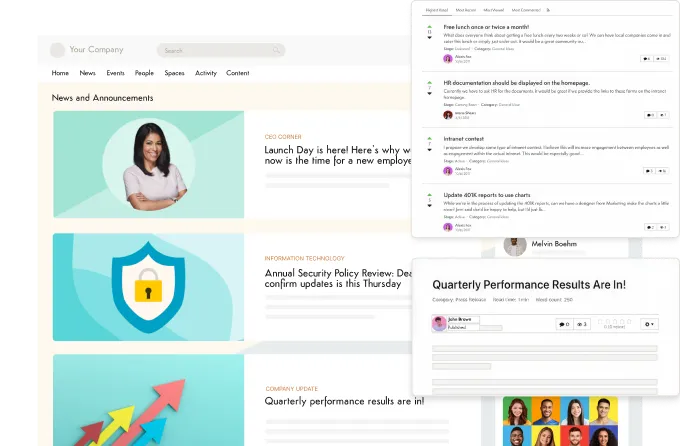
What the platform changes is what’s possible to do consistently at scale: publishing to a defined audience instead of everyone, confirming who acknowledged a policy change, letting a department update its own page without a ticket, reaching a shift worker on their phone, and seeing what employees searched for and didn’t find.
Axero gives communications teams one place to publish, target, track, and measure — read receipts, required reading, delegated publishing, a native mobile app, and AI-powered search across all of it, on an intranet platform employees have a reason to open daily, without needing IT for every update. See it in action.