
Permission sprawl
Access granted ad hoc and never revisited. Roles overlap, exceptions pile up, and 'who can actually see this space?' becomes a question no one can answer with confidence.
Intranet Governance
Open publishing, inherited permissions nobody reviews, and pages whose owner left two years ago — that's how an intranet drifts into risk. Axero gives IT the access control, approval workflows, content ownership, and audit trail to keep it defensible as it scales.
Trusted by IT and security teams at














The governance problem
Most intranets don't fail loudly. They drift — a permission here, an unowned page there — until the day someone asks who can see what, and nobody can answer. These are the failures IT inherits.
Access granted ad hoc and never revisited. Roles overlap, exceptions pile up, and 'who can actually see this space?' becomes a question no one can answer with confidence.
Pages outlive their owners. Policies go stale, duplicates multiply, and employees can't tell the current procedure from the one it replaced — so they stop trusting any of it.
When an auditor asks who changed a control document, when, and who approved it, an intranet without revision history and an approval trail has no answer. The gap is the finding.
Anyone can post anything, straight to live, with no review step. One wrong PTO policy or unvetted announcement reaches the whole company before anyone catches it.
Governance capabilities
Five controls, each tied to a job you own the consequences of — not a feature list.
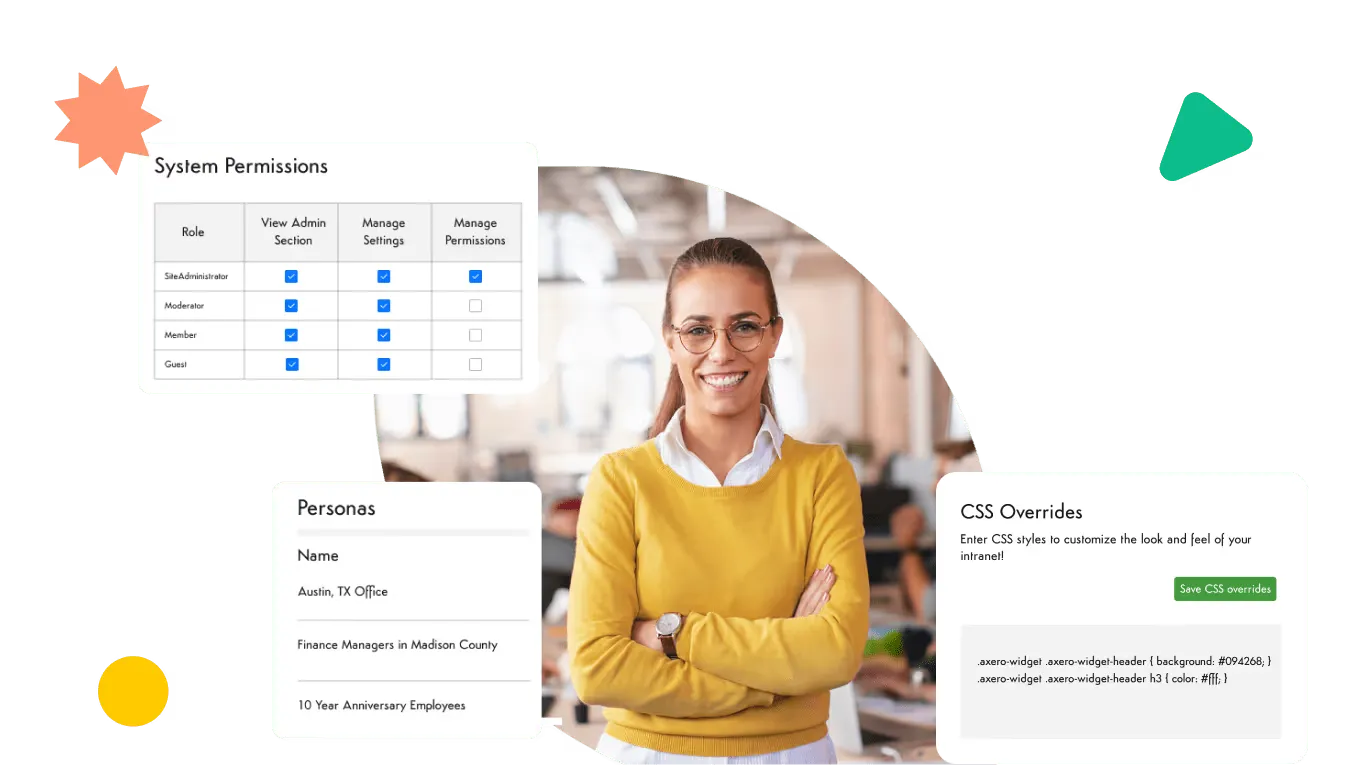
The job: enforce who-sees-what, and prove it. Axero runs on a fine-grained, role-based permission matrix. Permissions map to roles; each user can hold multiple roles; and access is set at the space, page, and file level — as broad or as granular as the data demands.
Confidential content stays invisible to everyone outside its role, and the same model governs the people directory and every workspace. When you need to answer "who can reach this?", the role matrix is the answer — not a guess.
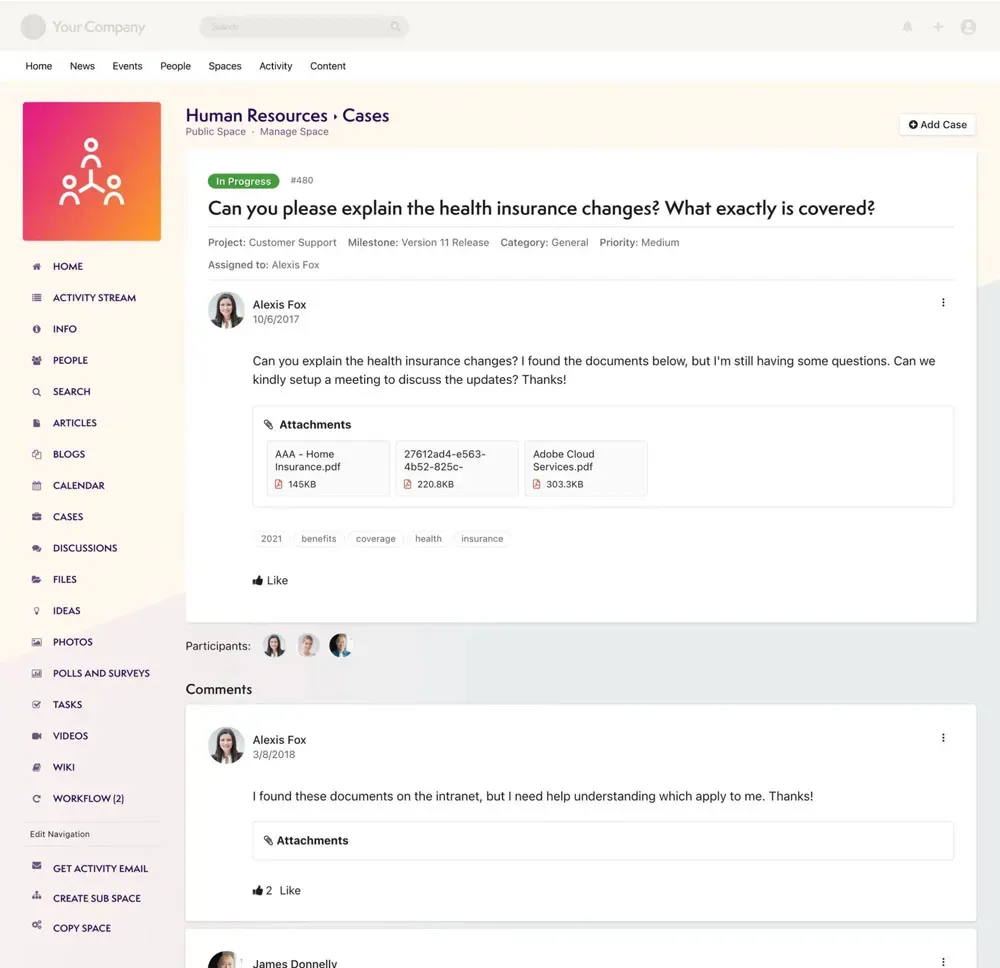
The job: stop ad-hoc publishing without becoming the bottleneck. Axero workflows put content through a defined series of moderation steps before it goes live — each step assigned to a role, with the number of steps set by the admin. Nothing reaches employees until the right people sign off.
That turns policy management from "hope someone reviewed it" into a repeatable, defensible process — the controlled path that company-wide communications and regulated policy content both need.
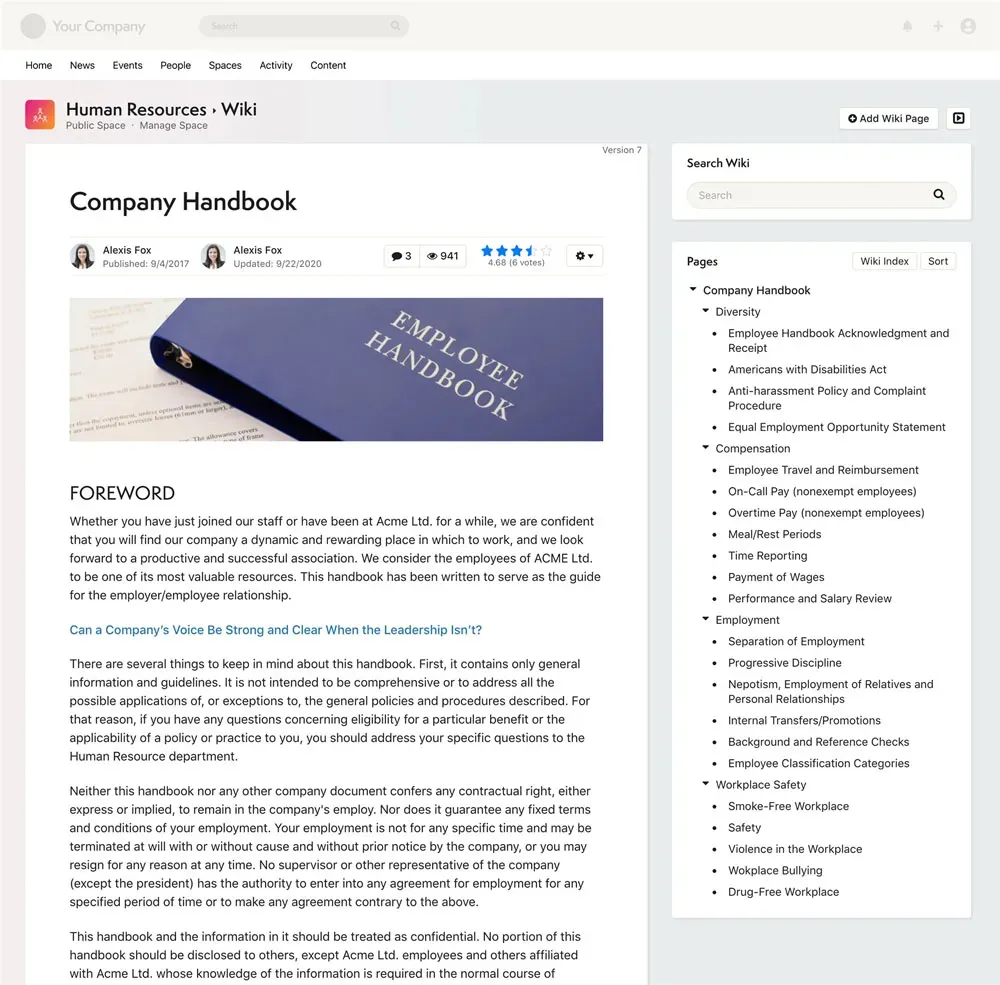
The job: keep content accountable from creation to retirement. Every page and document carries a revision history, so every change is traceable and reversible. Assign owners, schedule reviews, flag required reading, and retire content that's outlived its purpose.
It's the difference between a knowledge base people trust and one they route around. Ownership and review are governance controls, not housekeeping.
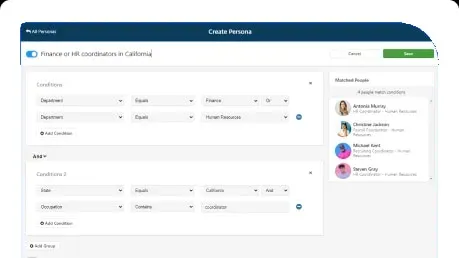
The job: govern at scale without funneling every change through IT. Delegate space and content administration to the departments that own the material, while IT keeps the permission model, branding, and system settings under central control.
Comms can publish a homepage update, HR can own its policy space, and IT can hand off content ownership by department without surrendering the access controls underneath. Granular admin rights mean delegation never means losing oversight.
The job: make access follow the controls you already run. Axero supports single sign-on with every major provider — Okta, Microsoft Entra ID / Azure AD, ADFS, OneLogin, Google, and SAML 2.0 — plus enforced 2FA, so authentication lives in your existing identity stack, not a separate password silo.
For full lifecycle automation, Axero exposes a SCIM 2.0 endpoint: your identity provider provisions, updates, and deprovisions accounts directly, with role syncing. Create a user in Okta or Entra ID and they appear in Axero; deactivate them and access is revoked automatically — no orphaned accounts. The Azure AD integration additionally syncs profile data and groups, and domain-based auto-assignment routes new accounts to the right groups.
Independently verified






Compliance readiness
Governance isn't real until it survives an audit. Here's the evidence Axero gives you to hand an auditor — certifications, attestations, and the trails that make a control defensible.
Axero is SOC 2 Type II compliant and our cloud hosting environments are SSAE 16 (SOC 1, SOC 2 Type II) attested. SOC reports are delivered on request — the documentation your vendor-review process asks for.
The cloud environment Axero runs in is ISO 27001 compliant, with single-tenant isolation so your data is never commingled with another customer's.
Our hosting environment complies to HIPAA standards and Axero will execute a Business Associate Agreement (BAA) to become joint custodians of PHI. GDPR, ADA, Section 508, and WCAG 2.0 documentation is available on request.
Revision history on every page and document means each change is traceable to who made it and when. Required-reading tracking records who acknowledged a policy — the logging that turns a control into a defensible answer.
Ongoing third-party network vulnerability scans, penetration testing, intrusion detection, and network monitoring run continuously — and the results back up your own security questionnaires.
AES-256 encryption at rest (FIPS 140-2), TLS 1.3 in transit, daily backups with defined retention, and a documented disaster-recovery program. For strict residency mandates, Axero can run self-hosted inside your own firewall.
Fits your stack
Axero doesn't ask you to govern access twice. Authentication, provisioning, and offboarding hang off the identity stack IT already runs — about 95% of our customers connect SSO.
Book a technical demo and we'll walk your IT and security team through the permission model, approval workflows, audit trails, and compliance documentation — no marketing detour.